Total Remote Care
Total Remote Care

Care that sees
around corners

Preemptive care for long-term facilities. Continuous monitoring that catches problems before they become emergencies, giving your team time to act.

Sunrise Ridge Care Center - Live Monitor
--:-- --
LIVE
24
Monitored
2
Needs Review
1
Alert Sent
97%
Uptime
Heart Rate
72 bpm
Stable
40Normal 60–100120
Respiration Rate
16 /min
Stable
0Normal 12–2030
Patients Flagged for Review3 of 24
MW
M. Williams Rm 108A
RR trending up over 4h - 22/min avg, CI +2.1
Alert
JD
J. Davis Rm 114A
HR low dwell - device connectivity flag
Monitor
SP
S. Park Rm 121C
7D HR avg 68 · RR avg 15 · Stable
Normal
Why Total Remote Care

The standard of care has changed

Facilities that wait for symptoms to appear are already behind. TRC puts your team ahead of every deterioration, every shift.

Always-On Awareness

Ambient sensors monitor every resident continuously: no wearables, no check-ins, no gaps. The system never sleeps, never gets distracted, never misses a shift.

Early Warning Intelligence

AI trained on clinical patterns identifies meaningful deviations in heart rate, respiration, and movement, alerting your team hours or days before a condition becomes a crisis.

Clinical-Grade Compliance

Every data point is captured, timestamped, and documented automatically. Your compliance record becomes a strength, not a liability, built in real time, not after the fact.

Staff Empowerment

Instead of reacting to emergencies, your nurses focus on care. Targeted alerts replace constant rounds, reducing cognitive burden and improving retention across your team.

Seamless Integration

TRC connects directly to PointClickCare, eClinicalWorks, Athena, and more. Data flows into your existing EHR automatically, with no double documentation or new workflows.

Revenue Optimization

RPM and CCM programs are reimbursable under Medicare. TRC handles the documentation, monitoring, and billing infrastructure that turns better care into sustainable revenue.

How It Works

From installation to intervention in days

A turnkey system your team adopts in hours, not months.

1

Install in Minutes

Our clinical team arrives and installs discreet ambient sensors in each room, with no construction, no drilling, no disruption. Residents don't change a thing about their routine.

2

AI Learns Each Resident

The platform establishes individual baselines for heart rate, respiration, and movement patterns over the first 72 hours. Every alert is personalized, not one-size-fits-all.

3

Your Team Intervenes Early

When trends deviate meaningfully, nurses receive targeted alerts with clinical context. The right person is notified at the right time, with enough lead time to act.

HIPAA Compliant
CMS Aligned
FDA Registered
SOC 2 Type II
EMR Integrated
See It In Action

Watch how TRC works

A real look at continuous monitoring, intelligent alerts, and proactive care, in under two minutes.

Explore

Learn more about Total Remote Care

Our Mission

Built for the nurses who carry the night shift

Walk into any skilled nursing facility at 3 a.m. and you'll find the same scene: a handful of dedicated nurses, dozens of residents, a clipboard in hand, and a nagging question: "What am I missing right now?"

TRC was built to answer that question before it becomes a tragedy. We believe every resident deserves to be watched over continuously, and every nurse deserves the tools to actually make that possible.

Our platform doesn't replace clinical judgment, it amplifies it. When our AI flags a trend, your team still makes the call. We just make sure they have the time and the information to make it well.

Nurse caring for patient
The Problem We Solve

The gap between check-ins is where harm happens

Traditional nursing care is episodic by nature. Rounds happen every hour, every two hours. But deterioration doesn't wait for rounds. A resident's respiration can shift hours before collapse. A heart rate pattern can signal infection long before fever appears.

The data is there in every rise and fall of every chest, every night. Until TRC, no one was listening continuously enough to act on it.

We close that gap permanently. Every resident, every room, every breath: captured, analyzed, and escalated the moment something matters.

Clinical monitoring
What We Stand For

Principles that drive every decision

Resident First

Every feature we build is evaluated through one lens: does this meaningfully improve the quality or safety of the care this person receives? If not, we don't build it.

Clinical Integrity

We don't chase vanity metrics. Our alerts are calibrated to reduce alarm fatigue, not feed it. The signal-to-noise ratio matters more to us than any dashboard statistic.

Trust Through Transparency

We handle sensitive health data with the seriousness it deserves. Our security posture, our compliance standards, and our data practices are never an afterthought.

Who We Are

A Miami-based team on a national mission

Total Remote Care is headquartered in Miami, Florida, and operates across skilled nursing facilities throughout the United States. Our team combines deep clinical experience with health technology expertise.

We work directly alongside facility administrators, directors of nursing, and attending physicians to ensure our platform fits into real workflows, not idealized ones.

Every implementation is handled personally. We don't hand you a login and disappear. We stay until your team is confident, your residents are covered, and your data is clean.

Meet the Team →
Miami office
See It In Action

TRC in a real facility

Watch how our platform transforms daily care operations.

See what proactive care looks like

Walk through the platform with one of our clinical specialists, with no sales pressure, just a real demonstration.

Schedule a Demo
RPM

Remote Patient Monitoring

RPM is your facility's nervous system, a continuous ambient awareness of every resident's physiological state. No wearables. No disruption. No gaps between rounds.

Sensors mounted discreetly in each room capture cardiorespiratory patterns and movement data around the clock. Our AI establishes each resident's personal baseline and watches for deviations that carry clinical weight.

When something matters, your team knows. Not after the fact - while there's still time to act.

Remote monitoring
RPM Capabilities

What your facility gets from day one

Continuous Vital Monitoring

Heart rate, respiration rate, and movement tracked 24/7 without any action from staff or residents.

Personalized Baselines

The AI learns each resident individually. Alerts are tuned to the person, not population averages that generate noise.

Intelligent Alerting

Clinically calibrated thresholds minimize alarm fatigue. Your team is alerted when it matters, not overwhelmed by noise.

Automated Documentation

Every data point logs automatically into your EHR. RPM minutes, thresholds, and alerts are documented for CMS billing without staff effort.

Trend Analysis

7, 14, and 30-day views surface gradual decline patterns that point-in-time assessments miss entirely.

Mobile Alerts

Nurses receive actionable alerts on their phones or tablets, with clinical context and not just a number, so they know how to respond.

CCM

Chronic Care Management

Most long-term care residents live with multiple chronic conditions simultaneously. Managing them in isolation - different providers, different schedules, different plans - creates gaps where complications grow.

CCM brings the whole picture together. Structured care plans, monthly clinical touchpoints, medication coordination, and care team collaboration, all orchestrated through a single platform and documented automatically.

The result: fewer acute episodes, tighter medication control, and residents who are more stable, more comfortable, and more engaged in their own care.

Chronic care management
CCM Capabilities

Structured care for complex patients

Individualized Care Plans

Structured plans tailored to each resident's conditions, goals, and care team, updated and versioned automatically.

Monthly Clinical Touchpoints

Scheduled care coordination calls ensure no resident falls through the cracks between physician visits, documented for CMS compliance.

Medication Management

Polypharmacy tracking flags potential interactions and adherence gaps before they compound into adverse events.

Care Team Coordination

Physicians, nurses, social workers, and specialists share a single view of each resident's status and history.

CMS Billing Ready

All CCM activity is automatically timestamped and formatted for Medicare billing, with no retroactive documentation required.

Condition Progression Tracking

Longitudinal views show how each chronic condition is trending, giving providers the context to adjust care before conditions worsen.

The Clinical Case

Why continuous monitoring changes outcomes

The most dangerous moment in long-term care is not a crisis. It is the hours before one, when the signs are present but no one is watching closely enough to see them.

72h

Before a Hospitalization

Clinical research shows that measurable physiological changes typically occur up to 72 hours before a resident requires emergency transfer. Continuous monitoring captures this window. Episodic check-ins miss it entirely.

#1

Cause of Preventable Transfers

Respiratory deterioration, detectable through respiration rate trends, is the leading cause of avoidable hospital transfers from SNFs. It is also the most consistently captured by ambient monitoring technology.

5+

Chronic Conditions Per Resident

The average SNF resident manages five or more chronic conditions simultaneously. Each one interacts with the others. CCM provides the structured coordination that prevents these interactions from compounding into acute events.

The RPM Opportunity

Medicare reimburses what improves outcomes

RPM and CCM are not just clinical programs, they are reimbursable services under Medicare. CPT codes 99453, 99454, 99457, and 99458 cover remote monitoring setup, device supply, and clinical review time. CCM codes cover monthly care coordination across chronic conditions.

For a 60-bed facility with 40 qualifying residents, properly documented RPM and CCM programs represent meaningful recurring revenue, generated by care your team is already providing, now simply captured and documented correctly.

TRC builds the documentation infrastructure that makes this billing defensible, consistent, and audit-ready from day one.

Explore Our Solutions →
Clinical documentation
RPM + CCM Together

The complete picture of resident health

RPM catches the acute: the overnight dip, the subtle vital shift, the early sign of deterioration. CCM manages the chronic: the diabetes, the CHF, the COPD that require constant, structured attention. Together, they form a care infrastructure that leaves nothing unmonitored.

See both programs in action

Our clinical specialists will walk you through a live demonstration tailored to your facility type and census.

Schedule a Demo
The Hardware

Ambient sensors. Zero wearables. Zero burden.

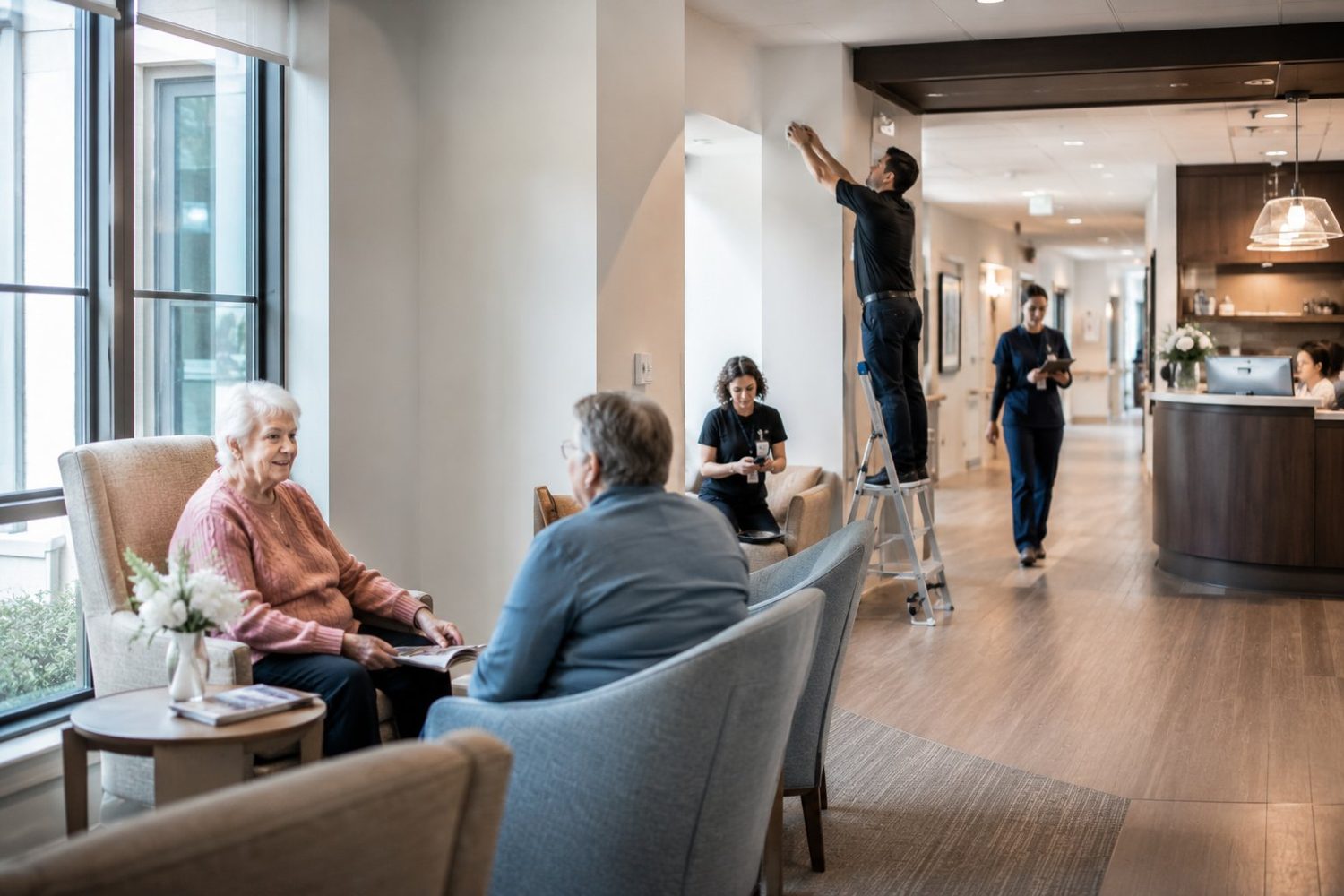
TRC's proprietary sensors are mounted discreetly in resident rooms, on the wall or ceiling, out of sight, never in the way. They capture micro-movements and cardiopulmonary patterns using non-contact, non-invasive technology.

Residents don't wear anything. They don't charge anything. They don't press any buttons. The monitoring is simply always on, completely passive and completely continuous.

Installation takes under 30 minutes per room. No construction, no wiring, no IT infrastructure changes required. Our team handles everything and clears the space before we leave.

Sensor technology
The Intelligence

AI that learns every resident individually

Population-level thresholds generate noise. A heart rate of 90 bpm means something very different for a resident whose normal is 65 versus one whose baseline is 88. Our AI knows the difference.

During the first 72 hours, the platform establishes each resident's unique physiological baseline. From that point forward, every alert is relative to the individual, not a standard clinical range pulled from a textbook.

The models are continuously updated as residents age, recover, or are admitted with new conditions. The system learns alongside your clinical team, not in spite of it.

AI platform
Integrations

Works with the systems you already use

TRC is designed to disappear into your existing workflow, not add a new one.

PointClickCare

Native integration with the most widely used long-term care EHR. Vitals, alerts, and CCM documentation flow in automatically.

eClinicalWorks & Athena

Bi-directional integration ensures your clinical data stays in one place, with no copy-paste and no duplicate records.

Real-Time Dashboard

A facility-wide command view for charge nurses and administrators, on any device or browser, secured with role-based access.

Mobile App

Nurses receive push alerts with full clinical context on iOS and Android, so the right person is always in the loop, wherever they are on the floor.

Encrypted Data Pipeline

All data is encrypted in transit and at rest. Zero PHI is stored in the sensor hardware itself, only your secured cloud instance holds resident data.

HL7 / FHIR Ready

Standard healthcare interoperability formats mean TRC can connect to virtually any modern clinical system your facility uses or plans to adopt.

Infrastructure

Enterprise-grade security from day one

TRC is built on a HIPAA-compliant cloud infrastructure with end-to-end encryption, multi-factor authentication, and granular role-based access controls. Every action taken in the system is logged and auditable.

Your residents' data never leaves your secured instance. Our sensors capture signals, not identifiable information, and all enrichment, storage, and analysis happens in your encrypted environment.

We undergo independent SOC 2 Type II audits annually and maintain continuous compliance monitoring between cycles.

Secure infrastructure

Want a technical deep dive?

Our implementation team can walk through architecture, security documentation, and integration specs with your IT leadership.

Request a Technical Review
Skilled Nursing Facilities

Run a safer, stronger facility

SNFs operate under relentless pressure: survey readiness, staffing ratios, hospitalization rates, star ratings, and the constant weight of caring for medically complex residents with finite resources.

TRC is designed to make that environment more manageable, not by adding complexity, but by giving your clinical leadership a clearer view of what's happening across every room at every moment.

When your nurses know, your facility leads. When your data is clean, your surveys go better. When hospitalizations drop, your reputation and revenue both improve.

Skilled nursing facility
For Facilities

What changes when TRC is in place

Survey Readiness

Continuous documentation and clean audit trails mean your records are always ready for state surveys, not assembled in a panic the week before.

RPM & CCM Revenue

Medicare reimbursement for RPM and CCM is available to qualifying residents. TRC handles the documentation infrastructure that makes billing defensible and consistent.

Staff Retention

When nurses have better tools and fewer reactive emergencies to manage, burnout decreases. TRC is an investment in your workforce as much as your residents.

Attending Physicians & Providers

The clinical context you've always needed

Attending physicians and NPs managing residents across multiple SNFs work from snapshot data: a note here, a call there, a visit once a week. Critical changes happen between those touchpoints.

TRC gives providers a longitudinal view of each resident's physiological status between visits. When something changes, you're notified with context, not just a number but the trend, the baseline deviation, and the timeline.

That context is the difference between a proactive medication adjustment and a 2 a.m. emergency transfer.

Physician reviewing data
Families

The peace of mind you deserve

Placing a parent or spouse in a care facility is one of the hardest decisions a family makes. The worry that follows, especially at night, on weekends, during holidays, is real and constant.

TRC means that even when you can't be there, someone is watching. Not every hour - every moment. And when something warrants attention, the clinical team is already moving.

Families at TRC-enabled facilities know their loved ones aren't waiting to be found. The system finds the change. The nurses respond. That's the promise.

Family visit

Ready to bring TRC to your facility?

Whether you're a facility administrator, a medical director, or a family member asking questions, we're here to help.

Get in Touch
Our Approach

Compliance is architecture, not an add-on

TRC was designed with regulatory compliance embedded into its foundation, not applied as a layer after the fact. HIPAA requirements, CMS documentation standards, and data security controls are built into every component of the platform.

This means your facility inherits a compliance posture from day one. When auditors ask for documentation, it's there. When surveys question monitoring records, they're airtight. When patients or families ask how their data is protected, you have a clear answer.

Compliance documentation
Certifications & Standards

Independently verified, continuously maintained

HIPAA Compliant

Full administrative, physical, and technical safeguards in place. BAAs executed with all downstream data processors. Breach response protocols tested and documented.

CMS Aligned

All RPM and CCM documentation follows CMS billing and quality reporting standards. Every minute logged, every threshold crossed, every alert sent, timestamped and formatted for reimbursement.

FDA Registered

TRC's monitoring devices are registered with the FDA as general wellness and clinical monitoring devices, with clinically validated accuracy for the vital signs they measure.

SOC 2 Type II

Independently audited security controls covering availability, confidentiality, and processing integrity. Annual audits, with continuous monitoring between cycles.

HL7 / FHIR Compliant

All data exchange follows healthcare interoperability standards, ensuring clinical data moves cleanly between TRC and your EHR without transformation errors or data loss.

Role-Based Access Control

Granular permission levels ensure that each staff member sees exactly what they need, and nothing they don't. Every access event is logged with timestamp and user identity.

Data Practices

Your data stays yours

TRC does not sell, license, or aggregate resident health data for any secondary purpose. Your facility's data is yours, used exclusively to deliver the monitoring and care coordination services you've contracted for.

Sensors capture physiological signals, not identifiable information. All identity linkage and enrichment happens within your encrypted instance, under your facility's BAA, with access limited to credentialed personnel.

We maintain a full data processing record at all times, exportable on request for legal, regulatory, or internal audit purposes.

Data security

Need our compliance documentation?

We can provide BAAs, security summaries, and audit reports upon request. Reach out to our compliance team directly.

Request Documentation
Contact

We'd love to hear from you

Our team includes clinical specialists who have worked inside skilled nursing facilities. When you talk to us, you're talking to people who understand your environment.

What to expect

A brief call with one of our clinical specialists, not a sales rep. We'll ask about your facility, your current challenges, and whether TRC is the right fit. No pressure, no jargon.

1
About You
2
Your Facility
3
Schedule
Tell us about yourself
Tell us about your facility
How would you like to connect?

📅 Calendly scheduling embed

Replace this with your Calendly inline embed. Sign up free at calendly.com, create an event type, and paste the inline embed code here.

- or send a message -
The Process

No surprises. No disruption. Just results.

Every TRC implementation is managed personally by our clinical team. We have done this enough times to know what derails adoption, and we have built our process specifically to avoid it.

Most facilities are fully operational within 5 business days of signing. Staff training takes under an hour. Residents experience zero disruption to their daily routine.

Below is exactly what to expect from contract through the first 90 days and beyond.

Implementation team
Implementation Timeline

What happens after you sign

Before Day 1

Pre-Implementation Planning

Your dedicated implementation manager contacts you within 24 hours of signing. Together you complete a brief intake covering facility layout, census, and EHR configuration. No heavy lifting on your end, we do the preparation.

  • Facility floor plan review and sensor placement planning
  • EHR credentials and integration setup initiated
  • BAA executed and compliance documentation delivered
  • Staff communication templates provided for your team
Day 1

Sensor Installation

Our technicians arrive on-site and install ambient sensors across your facility. Each room takes under 30 minutes. There is no construction, no wiring, and no disruption to residents or ongoing care activities.

  • All sensors installed, powered, and confirmed transmitting
  • Network connectivity verified on your existing infrastructure
  • Each sensor assigned to the correct resident and room
  • Facility dashboard live and accessible before we leave
Days 1–3

Baseline Learning Period

The AI spends the first 72 hours establishing each resident's individual physiological baseline. During this window, the system observes without alerting, collecting the data it needs to distinguish meaningful changes from normal variation.

  • Heart rate, respiration, and movement baselines established
  • Individual alert thresholds calibrated per resident
  • Historical trends begin populating in the dashboard
Day 2

Staff Training

We run a focused training session for your nursing and administrative staff. The platform is designed for busy clinicians. Training takes under an hour and covers everything from reading alerts to interpreting trend data.

  • Dashboard navigation and resident views
  • Alert response protocols tailored to your facility workflow
  • Mobile app setup for all nursing staff
  • EHR documentation walkthrough, covering how data flows automatically
  • Director of Nursing admin panel and reporting overview
Day 4 Onward

Live Monitoring - Full Operation

Alerts are active. Your team is receiving notifications. Data is flowing into your EHR. The system is fully operational and your implementation manager remains on-call for the first two weeks to answer any questions in real time.

  • Real-time alerts delivered to nursing staff
  • CMS-formatted documentation generating automatically
  • Daily summary reports available for charge nurses
  • RPM and CCM billing documentation live and auditable
30 / 60 / 90 Days

Ongoing Support & Optimization

TRC is not a set-it-and-forget-it product. Your dedicated customer success manager checks in monthly to review alert calibration, address any workflow friction, and ensure your team is getting maximum value from the platform.

  • 30-day clinical review: alert accuracy and threshold tuning
  • 60-day operational review: staff workflow and adoption
  • 90-day outcomes review: trends, hospitalizations, documentation
  • Quarterly business review with facility leadership
What You Need To Prepare

Almost nothing

We handle the heavy lifting. Here is the short list of what helps an implementation go smoothly on your end.

Wi-Fi Access

A stable Wi-Fi network or the ability to add a simple cellular gateway. Our team assesses connectivity requirements during pre-implementation.

An IT or Admin Contact

One point of contact for EHR access credentials and any internal IT approvals. One meeting, 30 minutes, and it is done.

Two Hours of Staff Time

One hour for installation coordination, one hour for training. That is the total ask from your team. We work around your schedule.

Updated Resident List

A current census with room assignments so sensors can be correctly mapped to residents before we arrive. We provide the template.

Ready to get started?

Schedule a demo and we will walk you through the full implementation plan for your specific facility.

Schedule a Demo
General
What exactly is Remote Patient Monitoring (RPM)?

RPM is continuous, technology-enabled monitoring of a patient's vital signs and physiological data outside of a traditional clinical setting. For long-term care facilities, this means ambient sensors in resident rooms that track heart rate, respiration rate, and movement 24 hours a day, without wearables, without interrupting residents, and without additional work for your nursing staff.

How is TRC different from a standard nurse call system or bed alarm?

Nurse call systems and bed alarms are reactive, responding after something has already happened (a fall, a button press, a resident leaving bed). TRC is predictive. Our AI monitors continuous physiological trends and identifies the patterns that precede a deterioration event, hours or days before it becomes a crisis. You are not responding to emergencies. You are preventing them.

Do residents need to wear anything or do anything differently?

No. TRC sensors are mounted in the room, not on the resident. There are no wearables, no patches, no devices to charge or wear. Residents continue their daily routines completely unchanged. Many residents are entirely unaware the monitoring is occurring, which also eliminates compliance issues common with wearable monitoring programs.

How long does installation take?

Sensor installation takes under 30 minutes per room. A typical 60-bed facility is fully installed in one day. Our team handles all installation. There is no construction, no drilling into walls, and no disruption to resident care or daily activities. Most facilities are fully live within 3 to 5 business days of signing.

Clinical
How does the AI know when something is actually wrong?

The system spends the first 72 hours after installation learning each resident's individual physiological baseline: their normal heart rate range, their typical breathing patterns, their movement behavior day and night. Alerts are triggered based on meaningful deviations from that personal baseline, not a one-size-fits-all clinical threshold. A heart rate of 90 bpm means something very different for a resident whose normal is 65 versus one whose baseline is 88. The AI knows the difference.

Will this create alert fatigue for our nursing staff?

This is one of our primary design concerns. TRC is built to reduce alarm fatigue, not contribute to it. Because alerts are personalized to each resident's baseline and calibrated for clinical significance, the signal-to-noise ratio is high. During the first 30 days, your implementation manager actively works with your team to tune thresholds to your facility's specific environment. If your nurses are getting too many alerts, we adjust. That is part of the ongoing service.

What vitals does TRC monitor?

TRC continuously monitors heart rate, respiration rate, and movement patterns. These three indicators, when tracked together longitudinally, provide the earliest detectable signals of the most common causes of deterioration in long-term care residents, including respiratory infections, cardiac events, sepsis onset, and dehydration. Our CCM program also incorporates additional condition-specific tracking integrated from clinical assessments.

What happens when an alert is triggered?

The assigned nurse receives a push notification on their mobile device and a dashboard alert. The alert includes the resident's name, room number, the specific vital sign or pattern that triggered it, the severity level, and a trend visualization showing the deviation from baseline. Your team decides how to respond. TRC provides the intelligence, your clinicians exercise the judgment.

Technical
What EHR systems does TRC integrate with?

TRC integrates natively with PointClickCare, the most widely used EHR in skilled nursing facilities, as well as eClinicalWorks, Athena Health, and other major platforms via HL7/FHIR-compliant APIs. If your facility uses a system not on this list, contact us. We have integrated with dozens of platforms and our technical team will assess compatibility during pre-implementation at no additional charge.

What are the network requirements?

TRC sensors can connect via your existing Wi-Fi infrastructure or via dedicated cellular gateways if Wi-Fi coverage is insufficient. Our implementation team conducts a connectivity assessment before installation to identify any gaps. Most facilities require no network changes whatsoever. For facilities with challenging infrastructure, we provide cellular gateway hardware as part of the implementation package.

Where is resident data stored and who can access it?

All resident data is stored in a HIPAA-compliant, SOC 2 Type II audited cloud environment. Each facility operates within its own isolated data instance, and your resident data is never co-mingled with another facility's data. Access is controlled by role-based permissions that you configure. TRC staff can only access your data with your explicit authorization for support purposes, and all such access is logged and auditable.

Billing & Compliance
Is RPM reimbursable under Medicare?

Yes. Medicare reimburses for Remote Patient Monitoring under CPT codes 99453, 99454, 99457, and 99458. CCM is reimbursed under CPT codes 99490, 99491, 99487, and 99489. Eligibility requirements apply and vary by patient. TRC generates all the documentation required to support billing, including time logs, device readings, clinical review records, and care plan updates, automatically and in CMS-compliant format. Your billing team submits; we do the paperwork.

Does TRC handle the billing itself?

TRC provides the documentation infrastructure and reporting required for billing, but we do not submit claims on your behalf. Your existing billing team or billing partner handles claim submission using the records TRC generates. If your facility does not have billing expertise for RPM and CCM, we can refer you to specialized billing partners we work with. We make the documentation bulletproof; your team or partner handles the submission.

What documentation does TRC provide for state surveys?

TRC maintains a continuous, auditable record of all monitoring activity, including every alert, every clinical review, every care plan update, and every vital sign data point. This record can be exported in standard formats on demand. Facilities using TRC have found survey preparation significantly less burdensome because the documentation is always current, always complete, and always accessible. Your surveyor asks for a record; you pull it in seconds.

Have a question we didn't answer?

Reach out directly and one of our clinical specialists will get back to you within 2 business hours.

Contact Us
SERVING FACILITIES NATIONWIDE
Coverage

Where TRC operates

From coast to coast, TRC partners with skilled nursing facilities, assisted living communities, and long-term care providers across every region of the United States.

🗺️

All 50 States

Licensed to operate in every state, with active facilities across major metro and rural markets

Rapid Deployment

Implementation team available nationwide, with most facilities going live within 5 business days of signing

🏥

Any Facility Size

From 30-bed rural SNFs to 300+ bed urban facilities, TRC scales to your census and floor plan

📞

Local Support

Regional clinical specialists provide on-site training and ongoing support in your area

Expanding Markets

Growing alongside the long-term care industry

The demand for remote patient monitoring in skilled nursing facilities is accelerating across every region. CMS reimbursement policies, state survey requirements, and post-pandemic staffing pressures have made continuous monitoring a strategic priority, not just a clinical one.

TRC is actively expanding its footprint in partnership with multi-facility operators, hospital systems with SNF affiliates, and independent facilities looking to lead their markets on quality metrics.

If you are located anywhere in the United States and want to bring TRC to your facility, our implementation team is ready to move.

Check Availability in Your Area →
Nationwide operations

Ready to bring TRC to your facility?

Tell us where you are and we will connect you with your regional implementation team within 24 hours.

Get Started Today
Call Us Schedule Demo